Expert-Ease Assistant

Ask me anything!

Hello! I'm here to help you with Expert-Ease. Are you a Teacher or a Parent?

Insights on learning, brain health, and screen-free education from Expert-Ease.

Digital dementia and brain recovery

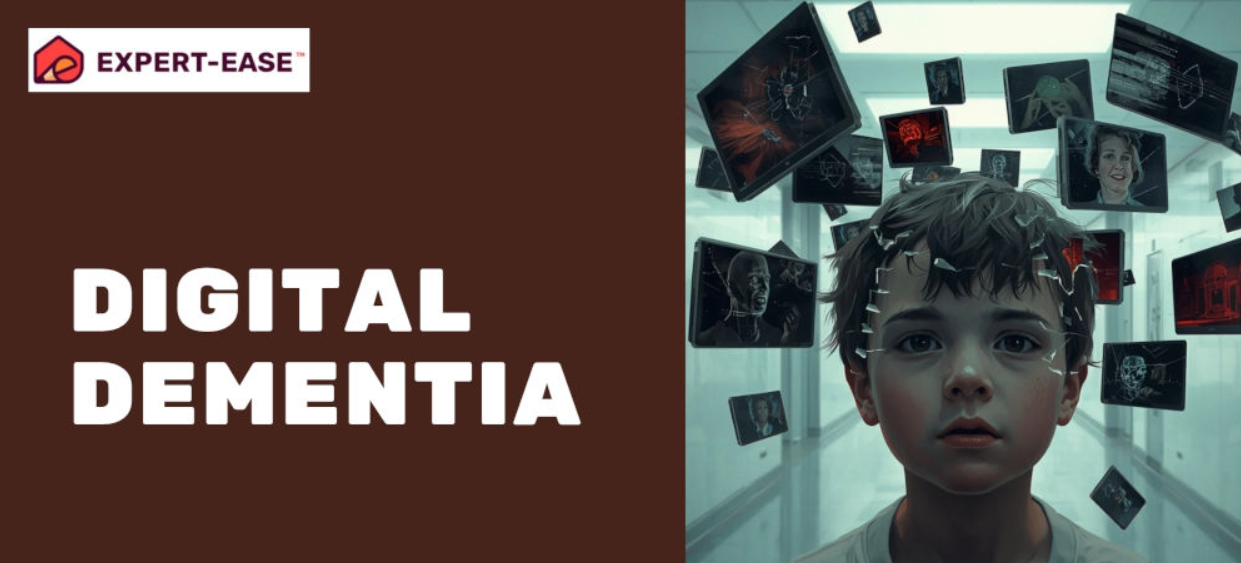
Digital Dementia: Good News! The Brain Can Recover

By Expert-Ease Team

Today, screens aren't just a part of our routine — they run our routine. From the moment we wake up to the moment we sleep, there's always a phone buzzing, or a laptop waiting for attention. Sure, these devices make life smoother, but quietly, almost invisibly, they're reshaping how our brains function. Kids forget things they learned yesterday, adults feel mentally exhausted even without doing much, and everyone seems to jump from one distraction to another without truly focusing on anything.

Experts now call this slow, silent shift "digital dementia" — a condition where heavy screen use weakens memory, focus, and deep thinking. And honestly, you don't need a scientist to tell you something is changing. Parents see it every single day at home: children scrolling while eating, teens getting restless the moment the WiFi drops, and even adults depending on Google for answers we once carried easily in our heads. It's happening around us, often unnoticed until the symptoms become impossible to ignore.

What Exactly Is Digital Dementia?

German neuroscientist Dr. Manfred Spitzer describes digital dementia as something we're all experiencing but rarely notice — a slow decline in memory, focus, and emotional stability due to heavy screen use.

Digital dementia is not the same as age-related dementia, but the pattern is disturbingly similar:

  • forgetfulness
  • trouble concentrating
  • emotional imbalance
  • mental fatigue
  • shallow thinking

And what makes it even more concerning? It's happening not just to adults — but to children and teens whose brains are still developing.

Digital Dementia Isn't Loud — These Are the Clues We Ignore

The Silent Cognitive Crisis

A quiet shift is happening to our brains — and most of us don't even realize it. Earlier, memory loss and slow thinking were mostly linked to old age. Today, researchers are seeing the same signs in people in their 20s, 30s, and 40s. Constant digital exposure and multitasking overload the brain, reducing its ability to store information and stay attentive for long periods. When the brain is always switching between apps, notifications, and screens, it struggles to slow down and process deeply. Over time, this affects memory strength and mental clarity.

Digital Amnesia & The Google Effect

Digital Amnesia happens when we forget information because we rely on devices to remember it. The Google Effect is when the brain stops trying to store information because it knows an instant digital backup exists. In simple terms: Your brain has shifted from "I'll remember this" → to → "I'll search it again." And this tiny change is reshaping our memory more than we realize.

Parental Parallel

Parents often don't realize they're facing the same issue as their children. Constantly relying on phones for reminders, directions, calculations, and answers leads to digital offloading — where the brain slowly stops exercising its own memory and thinking skills. Over time, this shows up as forgetfulness, lower mental stamina, and even anxiety when the phone isn't nearby. Children don't just hear what we say — they absorb what we do. When parents depend on screens for everything, kids learn to do the same.

Research describes this behavior as digital offloading — when adults rely on devices to perform basic cognitive tasks like remembering, planning, and decision-making. This screen dependency leads to reduced memory retention, lower mental endurance, and increased anxiety when disconnected.

Children mirror these habits through observation, not instruction. When parents externalize thinking to devices, the same cognitive patterns develop in children, turning digital overuse into a shared family-level brain health concern.

Accelerated Cognitive Aging

If you've ever unlocked your phone for one task and surfaced minutes later doing five different things, you've already experienced what researchers call fragmented attention. This constant digital switching doesn't just feel tiring — it slowly changes how the brain processes, stores, and recalls information. Cognitive decline in the digital age doesn't arrive overnight. It builds quietly through everyday habits: constant notifications, endless scrolling, and multitasking that never really stops.

Why Children Are Most at Risk: When Screens Become the New Tobacco

If adults are experiencing memory lapses, attention problems, and mental fatigue from constant digital exposure, the impact on children is even more serious. Unlike adults, children aren't adapting to screens — their brains are developing around them.

Research from the American Academy of Pediatrics shows that heavy screen use in early years is linked to weaker attention control, delayed language development, and reduced ability to self-regulate emotions — especially when screens replace real human interaction. This explains why many children today struggle to sit still, stay focused, or persist with tasks that require patience.

This is also why experts often say "screens are the new tobacco." Not because screens are inherently harmful — but because, like tobacco once was, their overuse is normalized, addictive, and quietly damaging over time. The effects don't appear overnight; they accumulate slowly, shaping habits, attention spans, and brain development long before the warning signs become obvious.

Kids Copy What You Do — How Parents' Habits Shape a Child's Brain

If there's one truth most parents agree on, it's this: children don't learn from instructions — they learn from observation. You can tell a child "Don't use the phone too much," but if you're scrolling during meals, checking notifications mid-conversation, or using screens to unwind, your child quietly absorbs that behaviour as normal.

Kids are like open tabs — whatever they see you do, they download instantly.

Here's what this looks like in real life:

  • If parents scroll to relax → kids see screens as the default comfort
  • If parents use phones during meals → kids copy it without thinking
  • If parents check notifications constantly → kids learn to stay distracted
  • If parents avoid boredom → kids never learn patience or deep focus

And here's the part most people miss: children copy how parents react to screens — not just how often they use them. A parent who gets irritated when the phone battery dies, checks the phone first thing in the morning, or keeps it within reach at all times, unintentionally teaches: "This is how important screens should be in your life."

Digital Dementia Is Reversible? Yes — And More Easily Than You Think

Here's the reassuring part every parent (and honestly, every adult) needs to hear: Digital dementia is reversible. Neuroscience research shows that the brain has neuroplasticity — the ability to repair and rewire itself when habits change. Studies indicate that reducing digital overload and reintroducing focused, real-world activities improves attention, memory, and mental endurance over time.

And the best part? You don't need drastic lifestyle changes. Small, daily habits consistently applied help the brain recover.

Simple Prevention Habits That Actually Work (For All Ages)

1. Build Micro-Breaks Into Screen Time (20-20-20 Rule)

The 20-20-20 rule isn't just internet advice — it's recommended by eye and brain health researchers to reduce digital strain. According to research published in medical journals on digital eye strain, continuous screen focus increases cognitive load and mental fatigue, while short visual breaks help reset attention and reduce overstimulation. That's why experts advise: Every 20 minutes, look 20 feet away for 20 seconds. These micro-pauses allow the brain's attention system to disengage briefly, helping reduce brain fog and improve focus over longer periods.

2. Use Gentle Digital Detox Moments (Not Extreme Rules)

Studies on screen exposure and sleep show that even small reductions in evening screen time improve sleep quality — and sleep directly affects memory consolidation and attention. Simple habits that work:

  • Phone-free meals
  • Screen-free first 20 minutes after waking
  • One calm, device-free hour before bed

Small gaps → measurable cognitive relief.

3. Reactivate the Brain With Mental Effort

Cognitive research shows that active recall (forcing the brain to remember without help) strengthens memory circuits more than passive information consumption. Bring back:

  • Memorising numbers
  • Mental math
  • Remembering directions without maps
  • Puzzles, crosswords, word games

Using the brain is how the brain stays strong.

4. Reconnect With Physical & Social Activity

Studies link physical movement and face-to-face interaction with better attention control and emotional regulation — areas weakened by excessive screen use. Outdoor play, walks, conversations, board games, and physical books give the brain the kind of stimulation it evolved for.

5. Calm the Nervous System to Restore Focus

Short mindfulness practices reduce stress hormones and improve attention span. Even 5 minutes a day of breathing, meditation, or chanting helps the brain shift out of constant alert mode.

Digital dementia doesn't require extreme detoxes. Science shows small, consistent changes are enough to help the brain recover — at any age.

How Expert-Ease Helps Children Learn Without Screens

At a time when most learning platforms are moving onto screens, Expert-Ease Tutorial Solutions Pvt Ltd. follows a simple but powerful belief: people don't need more screen time to learn better — they need focus, human connection, and mental space.

Expert-Ease caters to growing concerns around excessive digital exposure, reduced attention spans, and learning fatigue. Instead of adding to the problem, the platform offers a completely screen-free, in-person learning model that brings personalised education back into the home.

Beyond academics, Expert-Ease also supports co-curricular and physical activities for all age groups. Whether it's children exploring creativity through art and dance, teens building problem-solving skills, or adults and older learners engaging in music, yoga, or other hobbies — these activities help the brain exercise, stay active, and recover from digital overload.

In a world where screens are unavoidable, Expert-Ease doesn't aim to eliminate technology — it aims to restore balance. By reducing unnecessary digital dependence during learning hours, learners get the mental breathing space their brains need to grow stronger, sharper, and more resilient.

Because learning isn't just about access to information — it's about how the brain experiences it.